

EBC-Lite Electronic Boost Controller QA
Q1: Which vehicles is EBC-Lite suitable for?
A: EBC-Lite is compatible with turbocharged systems using a mechanical Actuator or external Wastegate controlled by positive pressure, where the solenoid valve can be externally connected to the boost control circuit.
These systems open the wastegate flap via boost pressure. Vehicles that use engine vacuum to hold the wastegate closed after startup are not compatible.
Q2: Can EBC-Lite be used on 24V vehicles or trucks?
A: Not compatible.
EBC-Lite is designed for 12V automotive electrical systems. 24V vehicles such as some trucks, commercial vehicles, or large diesel vehicles are not recommended.
Q3: Can EBC-Lite reduce boost pressure?
A: It cannot go below the spring base pressure.
EBC-Lite can adjust boost above the base pressure, but cannot reduce it below the spring's actuation pressure.
If you need to lower boost or readjust the boost curve, first check the spring rating and replace with a lower-rate spring if necessary.
Q4: Does using EBC-Lite require ECU tuning?
A: Not necessarily — it depends on the adjustment range and the vehicle's condition.
For small adjustments where the air-fuel ratio remains within a safe range, ECU retuning is generally not required. If boost pressure increases more than 0.3 bar above the original baseline, it is recommended to log data and perform ECU tuning to ensure the engine can safely handle the new boost level.
Q5: Does EBC-Lite installation require a professional technician?
A: Installation by a technician with experience in turbo systems and automotive wiring is strongly recommended.
EBC-Lite requires proper connections for the power supply, pressure sensor, solenoid valve, and associated pressure lines. Incorrect wiring or plumbing may result in abnormal boost control or the risk of overboost.
Q6: What is the PEAK function used for?
A: The PEAK function records the highest boost pressure reached in each mode.
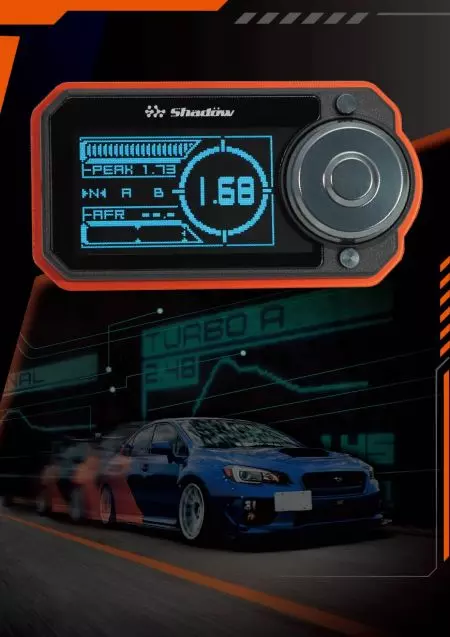
This helps confirm whether the actual boost is within the intended range, and assists in diagnosing overboost, boost drop, unstable hold pressure, or settings that need adjustment.
Q7: What is the High Boost Limit?
A: High Boost Limit is the overboost protection setting on EBC-Lite.
When actual boost exceeds the set value, the system activates a protective response and flashes the display to alert the user that pressure has exceeded the safe threshold.
Q8: What boost pressure range can EBC-Lite control?
A: EBC-Lite supports a pressure range of -1.0 ~ 3.0 bar (-14.5 ~ 43.5 PSI).
The actual safe boost target still depends on engine condition, turbo specifications, fuel system, ignition setup, cooling efficiency, and ECU calibration.
Q9: What can the AUX output be used for?
A: EBC-Lite provides an AUX output rated at +12V / 1A.
Each mode (A / B) can independently set an AUX trigger threshold — the output activates when boost reaches the set value and deactivates when it drops below.
It can be used for relays, water injection systems, overboost warning lights, external alert devices, or any equipment that accepts a +12V trigger signal.
Q10: What is the difference between EBC-Lite and DEBC II?
A: EBC-Lite follows the same electronic boost control logic as DEBC II, but features a more compact display and a simplified interface — focused on easy installation, intuitive operation, and core boost control.
DEBC II is the advanced version, offering additional features including external Wideband AFR signal input, lean-burn protection, and boost bleed protection — suited for users who need more comprehensive safety monitoring and advanced tuning capability.
- Related Products
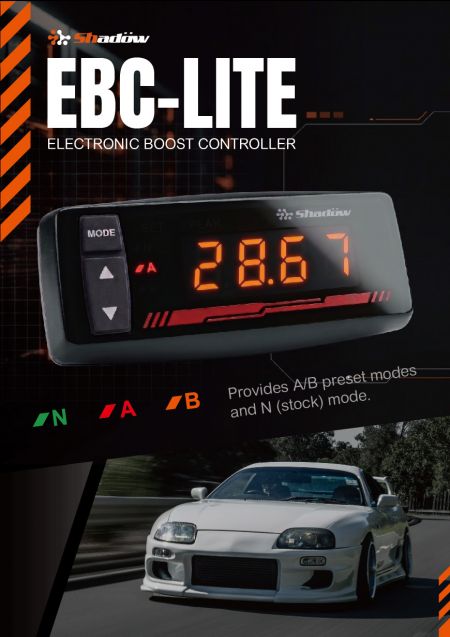
EBC-Lite Electronic Boost Controller
SW16019-28
EBC-Lite is an electronic boost controller developed from Shadow's DEBC II control logic. With a more compact display and simplified interface, operation is more intuitive, and installation is cleaner and more streamlined. For turbocharged vehicles, precise boost control is the foundation of stable power output. EBC-Lite helps users take control of when boost engages, how quickly pressure builds, how stable the plateau is, and when to protect.
Know you the best
SHADOW will not only be a pronoun of global automotive electronics products in the future, but also a good partner for modified car owners! Let more people experience the pleasure and convenience of modified vehicles through SHADOW's products!
Advantage
Water Temperature Gauge The Shadow Water Temperature Racing Gauge features a highly responsive needle that provides real-time, accurate readings of coolant temperature, allowing drivers to monitor engine conditions at all times... Read More